

The ReDiPack: A Green Collaboration
Use Cases
Create, publish and manage Digital Product Passports. Prepare for the 2027 Battery Passport and upcoming steel and cement rules, building on your existing data and production.






Industry-Specific DPP Solutions
From mandatory battery passports to emerging requirements for steel and cement, GoodsTag helps manufacturers structure product data, connect production systems and prepare for digital compliance.
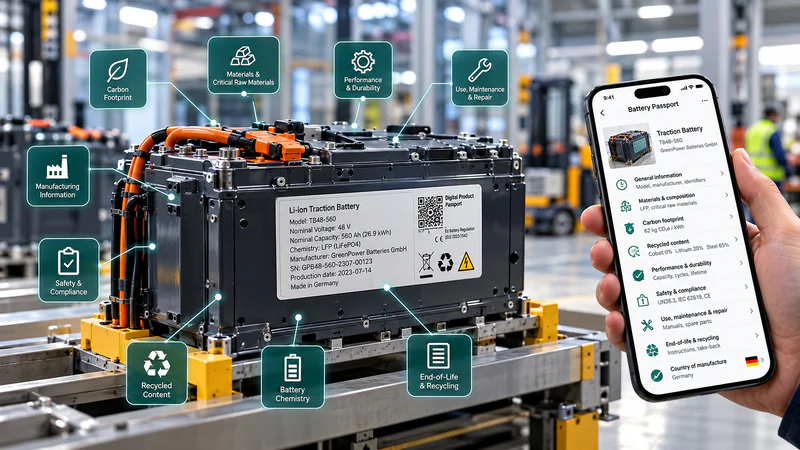
Mandatory from 18 February 2027
Prepare for the EU Battery Regulation with QR-linked passports for EV, LMT and industrial batteries above 2 kWh. Connect production data, manage passport integrity and support long-term availability.

ESPR requirements in development
Get ready for emerging EU requirements. Structure heat and batch data, material composition, emissions and traceability information before the final sector-specific rules take effect.

CPR requirements in development
Prepare product and material data for evolving European construction requirements. Connect cement composition, clinker information, environmental performance and conformity documentation.
GoodsTag connects product identities, supplier and manufacturing data, structured digital passports and QR-linked information experiences in a single infrastructure.
Bring together product information from ERP, MES, PLM, supplier files and APIs.
Build structured DPP records with controlled updates, access rights and version tracking.
Support cryptographic integrity, independent backup and long-term passport availability.
Adapt data models and publication processes as sector-specific rules are finalised.
The core capabilities behind every GoodsTag Digital Product Passport. Built to meet the data, identity and access rules of each regulation, and to keep every passport current for its whole lifetime.
Every product gets a unique, persistent identifier: the anchor that links the physical product to its passport.
GS1 GTIN and Digital Link, or your own schemes, including identifiers you already use.
Issue passports at the granularity each regulation requires, with parent-child links between levels.
Create and manage identifiers in bulk from templates and traceable production orders.
QR codes, Data Matrix, NFC or RFID tags that resolve to the right passport.


One verified record per product that gathers compliance data from your systems and suppliers across the lifecycle.
Map ERP, PLM and supplier data to the data model of each delegated act.
Request, collect and check evidence such as carbon footprint and recycled content from suppliers.
Connect machines and lines to create passports and pair data carriers during production (encoding).
Check that data is complete and consistent before a passport is published.
Publish each passport in the required format and show every audience the data it is entitled to.
Public data for consumers, restricted data for recyclers, repairers and market surveillance authorities.
Readable passport pages in the reader’s language, generated from your product data.
Structured data and APIs for registries, customs and business partners.
Battery Regulation, ESPR and other acts, updated when requirements change.


Turn passport data into evidence: track coverage, gaps and deadlines across your product portfolio.
See which products have complete, valid passports and which still lack data.
Build views for compliance, sustainability and product teams.
Track carbon footprint, recycled content and other declared values over time.
Export evidence for audits, customers and ESG reporting.
Microservices, API-first, cloud-native architecture built to keep passports available and trustworthy for years.
Connect ERP, PLM and MES systems such as SAP S/4HANA.
Records can be cryptographically signed and timestamped, with a full version history.
Fine-grained permissions for every user, supplier and organization.
Passports stay online for the period each regulation requires, with independent backup options.

Knowledge & Insights
Practical insights on EU Digital Product Passports, manufacturing data, regulatory developments and implementation challenges.
Practical implementation guidance: QR codes, supplier data, compliance testing and production integration.
Emerging EU requirements for steel: carbon information, material traceability and production data readiness.
CPR developments for cement: product and material passports, carbon information and documentation needs.
Beyond compliance
The same product identity that meets DPP rules can also power traceability, circular packaging and consumer engagement around your products.
A Digital Product Passport is a structured, machine-readable record of verified product information: materials, origin, environmental performance, repair and end-of-life handling. It is reached through a data carrier on the product, such as a QR code, and serves customers, recyclers and authorities.
Batteries come first: EV and LMT batteries and industrial batteries above 2 kWh need a battery passport from 18 February 2027 under Regulation (EU) 2023/1542. Other product groups follow through ESPR delegated acts. For iron and steel, adoption is planned for the fourth quarter of 2026, with requirements applying at least 18 months later.
GoodsTag has dedicated DPP solutions for batteries, iron & steel and cement, as well as fashion, detergents, furniture, electronics, chemicals, construction products and toys. See all industries.
The applicable act sets the content for each product group. Typical data covers identifiers, the manufacturer, material composition, substances of concern, carbon footprint, recycled content, repair and recycling instructions, and documents such as the declaration of conformity.
Each passport has a unique identifier linked to a data carrier, typically a GS1 Digital Link QR code. Access is tiered: consumers see public information, while recyclers, repairers and market surveillance authorities can be granted the restricted data they are entitled to.
Our implementation guide links a free readiness assessment and a baseline checklist for each industry. The assessment scores your data, identification and IT readiness and returns a prioritised action plan.
Yes. GoodsTag is API-first: REST interfaces and data mapping templates connect ERP systems such as SAP S/4HANA, PLM, MES and supplier portals, and EPCIS 2.0 events keep lifecycle data in sync. This limits manual entry and keeps every passport current.
Every data record in a passport can be cryptographically signed and timestamped, and hash-based verification makes any change traceable. Versioning and role-based access control ensure that only authorised contributors can add or change product data.
For batteries, iron & steel and cement, plans start at 300 € a month (Starter), with Pro at 800 € and Scale at 1,500 € a month, excluding VAT. Enterprise and other industries are priced on request. See pricing.
Yes. The same product identity that carries your passport can power traceability, circular packaging, authentication and consumer engagement. Discover the Smart Products Platform.


